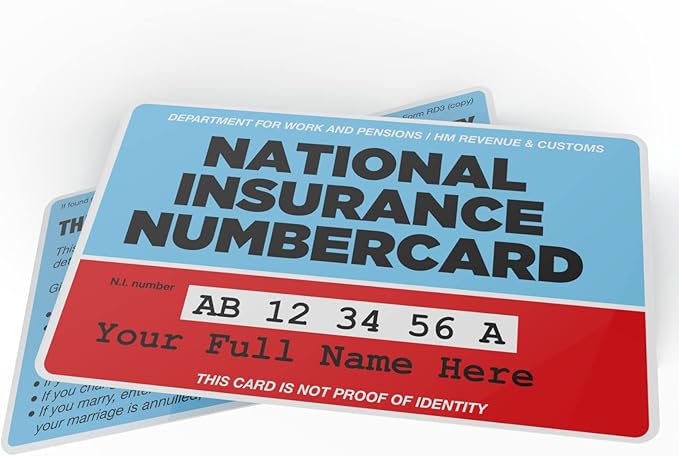
Helping citizens access their National Insurance Number
Client: HM Revenue & Customs
TLDR: Transforming a paper-based National Insurance Number service into a digital solution featuring Apple/Google Wallet integration, reducing £3.5m annual costs and improving access for young people.
Overview
I worked as part of the Single Customer Account (SCA) programme at HMRC to redesign how UK citizens access their National Insurance Number (NINO). The existing service was predominantly paper-based and resulted in over 500,000 calls annually, costing HMRC £3.5 million per year to manage.
The NINO is a critical reference number used across government for tax, National Insurance contributions, benefits, state pension, and student loans. However, many citizens struggled to find their number when they needed it, particularly young people entering work or education.
Challenges
The project presented several significant challenges:
Identity verification at scale
One of our biggest challenges was verifying a person's identity before displaying their NINO. Young people in particular had limited options for verification - they often didn't have a passport, driving licence, or established credit history.
We explored innovative solutions like using a young person's bank account to verify their identity, or displaying a child's NINO within their parent's or guardian's tax account.
Cross-government coordination
The NINO is jointly owned by HMRC and the Department for Work and Pensions (DWP), with DWP owning all the legislation. Any process changes required cross-government policy alignment, which added complexity to decision-making and implementation.
Our work overlapped with the GOV.UK One Login project, and we had to carefully coordinate our identity and verification approaches with their developing standards.
Security versus accessibility
We needed to balance making the service more accessible while maintaining strict security. Displaying sensitive information like a NINO digitally introduced risks around fraud and data breaches. Some of our ideas - like adding QR codes to letters for easy verification - were rejected as security risks, even though they would have significantly improved the user experience.
Digital exclusion
49% of 16-24 year olds failed online verification checks, often due to having no digital footprint or poor quality data in HMRC systems. We had to ensure our solutions didn't exclude vulnerable users who couldn't verify themselves digitally.
Research and discovery
Understanding the problem space
We conducted extensive research to understand the full scope of the problem:
- Interviewed 48 users across different age groups and circumstances
- Held focus groups with contact centre staff who dealt with NINO queries daily
- Analysed NINO letters sent annually to 15-year-olds (costing £252,000)
- Reviewed existing research from previous HMRC and DWP teams
- Mapped end-to-end journeys across multiple channels (online, phone, post)
Our research revealed that 78% of all NINO-related calls came from people under 25, with 52% from 16-17 year olds specifically. Many had never received their NINO letter, or had lost it and couldn't access it when needed (for example, when applying for university or starting their first job).
Creating mindsets instead of personas
Rather than traditional personas, we created 'mindsets' based on two key factors that influenced how users experienced the service:
- How 'tax/benefit/work experienced' they were
- How 'organised' they were
This approach was more flexible than classic personas and better reflected the reality that users could move between different mindsets depending on their life circumstances.
Mapping pain points
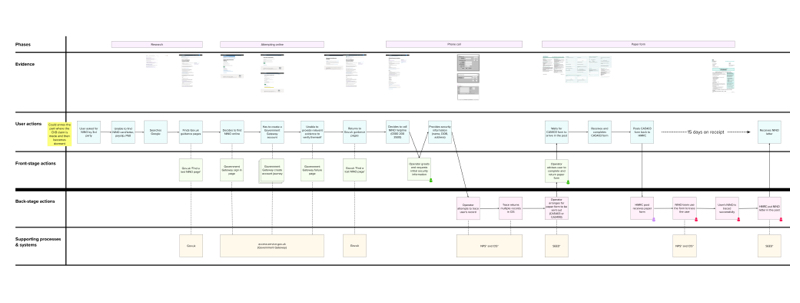
We created detailed service maps showing all the pain points users experienced, such as:
- Confusing GOV.UK guidance sending users to the wrong places
- Third parties (employers, universities, pension providers) misusing NINO as an identity verification tool
- Long delays (up to 15 working days) to receive a NINO confirmation letter
- Users unable to verify themselves online being forced to complete paper forms
- Confusion between HMRC and DWP services, with users passed between departments
Universal barriers and digital inclusion
We examined the service through the lens of universal barriers to identify where users were being excluded. We spoke to five users with accessibility needs covering emotional, auditory, learning/cognitive, visual, and motor/mobility requirements.
This work revealed significant gaps in how we supported users with low digital skills or those facing barriers to accessing online services.
Solutions and prototyping
We developed eight hypotheses to test in Alpha, covering:
- Enabling parents to maintain their child's information and access their NINO
- Creating an online 'Find my NINO' service
- Enabling digital storage outside HMRC services
- Improving the NINO confirmation letter
- Better GOV.UK guidance and signposting
- Automatic upgrade of Customer Reference Numbers (CRNs) to NINOs
- Shared verification between DWP and HMRC
- Progress updates for NINO applications
Digital wallet integration
Some of these solutions came up against significant resistance but we manage to forge ahead with some.
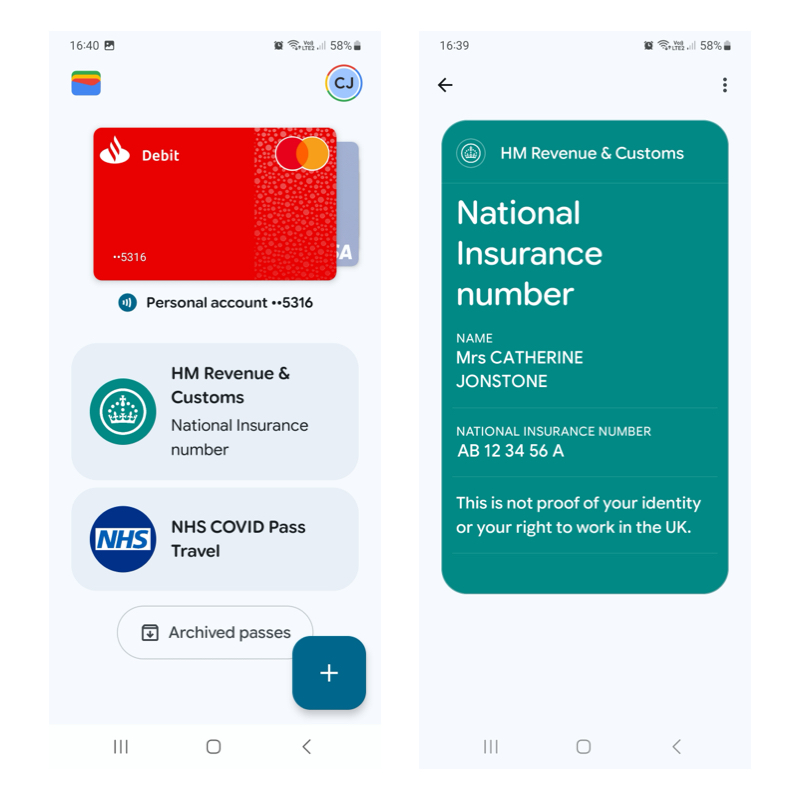
The most successful solution we developed was enabling citizens to add their NINO to their Apple or Google Wallet. This used a secure digital card type that meant people could access their NINO quickly using their existing wallet security credentials (Face ID, fingerprint, or passcode).
This solved multiple problems:
- NINOs were easily accessible when needed
- Users didn't need to remember the number or keep paper documents safe
- The wallet's built-in security meant we could trust the device-level authentication
- It worked for young people who were already comfortable with digital wallets
Redesigning NINO letters
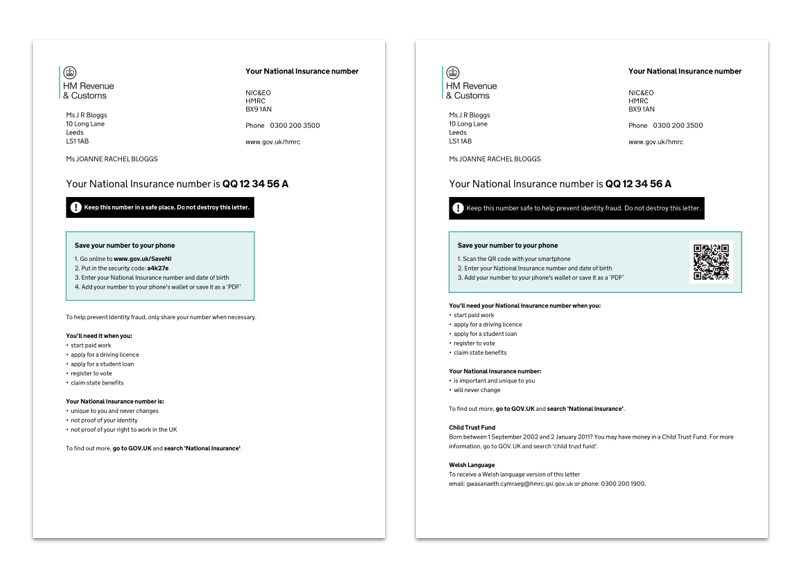
We worked with the Behavioural Insights team to redesign NINO letters, encouraging citizens to:
- Log into their Personal Tax Account
- Save their NINO to their digital wallet
- Understand what a NINO is and when they'd need it
The new letters acted as a 'call to action' rather than just a notification, driving digital adoption at the moment when citizens were most engaged.
Outcomes
The add-to-wallet feature for digital NINO cards successfully passed our Alpha assessment and is now live in the Personal Tax Account. Many users have adopted this feature, reducing the volume of lost NINO queries.
Key achievements:
- Reduced contact centre demand by giving users instant access to their NINO
- Created a model for secure digital distribution of sensitive government information
- Met WCAG 2.1 AA accessibility standards throughout the new service
- Influenced cross-government thinking about digital identity and verification
- Documented a plethora of potential solutions for future and parallel UCD teams to consider
The project demonstrated how user-centred design and thorough research could transform a decades-old paper-based system into a modern digital service that better met user needs while maintaining security and reducing costs.